
No, Stephen Colbert Isn't A Catholic Mystic
On the eternal death of heaven, theologies of vagueness, Karen Elizabeth Park, the late The Late Show With Stephen Colbert, and how the choirs of angels contradict a former comedian

The Catholic Church has a long tradition of eschatology, the theology concerned with the end times and our final destination. Stephen Colbert has a much shorter tradition of ignoring these teachings.
Last week, Colbert answered Jim Gaffigan’s question, “What do you think happens when we die?” thisly:
I think of it’s more like a feeling, I think there is some continuance of some kind, but it’s like a dispersion of the self into some other greater being, and I don’t have any feelings beyond that.
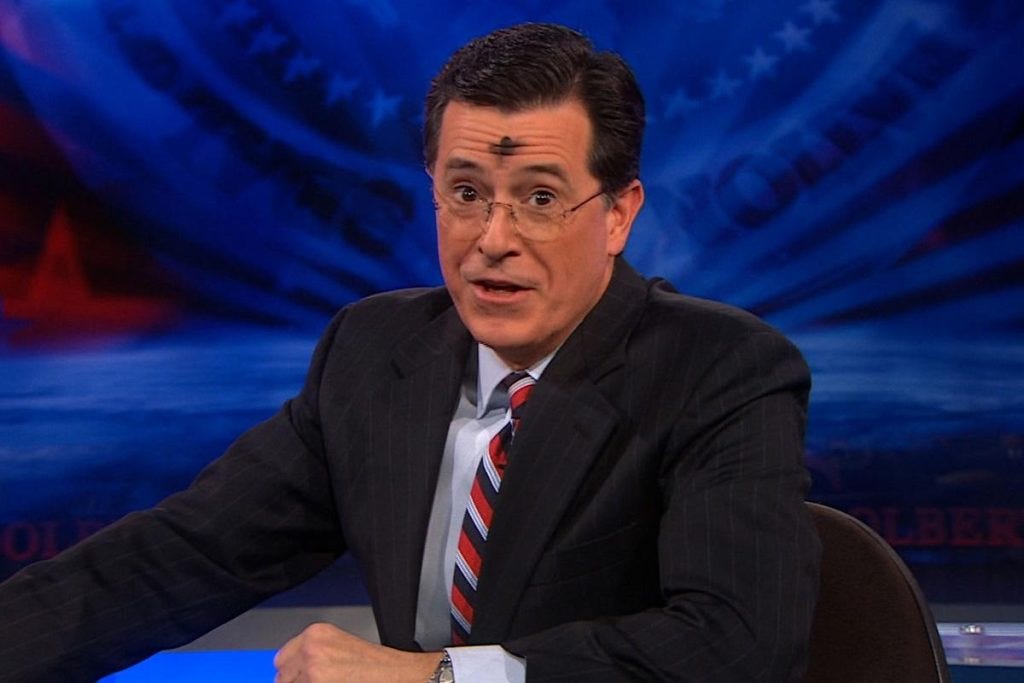
This would be a tolerable answer from an agnostic, as it could serve as a foundation for dialogue, but what makes this answer dubious is the fact that Colbert is an avowed Roman Catholic.
My contribution to this discussion is a few layers deep. Multiple conservative Christian outlets lambasted the response, accusing it of being New Age or pantheistic or just downright un-Catholic. In response Karen Elizabeth Park wrote a Substack piece called “The Catholic Mystics Would Have Understood Stephen Colbert’s Answer About Death” in which she argues that the Catholic mystics would have understood Stephen Colbert’s answer about death. I am responding to that piece.
Sed Contra: Colbert vs the Catholic Creeds
Karen goes so far as to shift the blame from Colbert onto his critics, saying,
The problem is not that Colbert has somehow wandered too far from Catholicism. The problem is that many modern American Christians, Catholics included, have been exposed to so little of their own tradition that they no longer recognize it.
Before responding to the article’s main contention about the Catholic mystics, let’s do a preliminary evaluation of Colbert’s comment in reference to creedal Catholicism in order to get a sense for whether he has “wandered too far from Catholicism.”
The Nicene Creed, which is recited by every practicing Catholic at every Sunday mass, begins by affirming monotheism (“We believe in one God”), which is already much more precise and definitive than Colbert’s “some other greater being.” But the creed goes on to name this God and even identify one of his essential attributes (“the Father, the Almighty”) before placing him in relation to us (“maker of heaven and earth, of all that is, seen and unseen”). After all this specificity about the Father, the Creed goes on to specify another entire person in God, details his relation to the Father, his role in creation and salvation history, before naming the third person of the Trinity and his work through the prophets, the church, and salvation. All of this positive assertion should be compared to Colbert’s “some other greater being.” Colbert identifies himself with this creed by calling himself Catholic, which makes his unnecessarily vague “some other greater being” somewhat strange.
The other most ancient and universal creed of Catholicism, the Apostle’s Creed, gives a more fleshed out description of salvation: “I believe in the Holy Spirit, the holy catholic Church, the communion of saints, the forgiveness of sins, the resurrection of the body, and the life everlasting.” It is perhaps questionable whether “a dispersion of the self” qualifies as “life everlasting” since it rings more of death than life. A communion of saints is certainly precluded as one cannot have a community of individuals once individuality is annihilated. Finally, if Colbert’s answer is truly Catholic, then either our resurrected bodies are dispersed along with our souls or somehow a dispersed soul retains the particularity of its body. Either option presents more like hell than heaven and I would like to stop imagining this “heavenly” centipede human, so we now move on to Karen’s main contention.
Scripture and Self-Denial
Karen’s defense of Colbert rests on the premise that his answer fits inside the Catholic mystic tradition. She says,
American Christians imagine death as a state in which the autonomous self survives intact forever. But this idea of the eternal persistence of the glorified self is not the only way that salvation or the afterlife has been understood in the Christian tradition. In fact, again and again, the mystics speak not about preserving the ego but surrendering it to God or, as Colbert put it, “some greater being.”
She claims that the mystics understood the afterlife to involve surrendering one’s ego to God, denying individuality in heaven. To justify this claim, she cites the practice of Benedictine monks, quotes three well-respected mystics—Meister Eckhart, John of the Cross, and Teresa of Avila—and implies that other theologians like Aquinas, Bonaventure, and Hildegarde would likewise agree.
While the mystics do use language that implies the dissolution of the self, we must discern whether by “self” they mean one’s will and desires (i.e. pride) or else one’s individuality on a metaphysical level. Is this humility or the annihilation of a human being? The subtle difference is striking.
But does this dispersion really entail the annihilation of the person? Throughout the article, Karen denies that “the autonomous self survives intact forever” or that heaven is “the eternal persistence of the glorified self,” describing instead as a “hollowing out” or the end of “the intact continuance of the self,” and the spiritual life as “eliminating the ego” and “the gradual destruction of the self’s illusions about its own permanence and autonomy.” I take her to mean that the soul will no longer experience things as an individual consciousness, yet aspects of the person will continue to exist as part of a larger whole. This is a description of eternal death. Without a body to keep the person distinct from another, consciousness remains (the principle of self-awareness, attention, individual ideas and willed desires) as the distinctness. With this taken away, everything that makes a human person a human person is gone, namely both body and soul. What of those pieces that are absorbed into God’s being? One of the logical consequences of considering God to be the Uncaused Cause is that He must contain the perfections of all things within His nature. In other words, He is all Being, its principle and fullness. What then can we add to Him besides our individuality? Without the blessing of individuality, every bit of us absorbed into His Being will add nothing to Him; it is eternal death by redundancy. So dispersion of the soul is an eternal death, which makes it closer to hell than to heaven.
What did the mystics think of this dispersion? We can first turn to Scripture, which is the origin of all good Catholic mysticism. The Bible is clear that the spiritual life requires a denial of one’s will and desires, or an emptying of oneself, but not a denial of metaphysical individuality. Christ says, “If any man will come after me, let him deny himself, and take up his cross, and follow me” (Matthew 16:24). To deny one’s self here must mean the denial of one’s own will and desires which make your will different from God’s will. For it would be absurd for someone who has denied his own individuality to perform actions like taking up a cross or following Christ since there would no longer exist an agent to perform the actions. Similarly, Paul writes, “I am crucified with Christ: nevertheless I live; yet not I, but Christ liveth in me” (Galatians 2:20) while he is still alive and an undeniable individual in the world. This passage requires that we understand both that he has retained his individuality and that he has emptied himself of his own will and desires.
The Deceptive Clarity of Catholic Mystics
To address Karen’s reading of the three mystics, I make two claims to help us interpret their relevant passages: (i) when a mystic refers to denying oneself while on earth, he is describing the way of humility, which implies nothing definite about the afterlife, and (ii) when a mystic refers to the dissolution of “the self” in the afterlife, the context of his other writings and the teachings of the church require us to understand “the self” as whatever makes one’s will distinct from God’s rather than one’s metaphysical individuality. If these two claims hold up for every passage, then none of the mystics imply a dissolution of the self which would corroborate Colbert’s spirituality.
The first mystic that Karen relies on is Meister Eckhart:
The fourteenth-century Dominican mystic Meister Eckhart repeatedly described the spiritual life as a radical emptying-out of possessiveness, ego, and self-will. He wrote: “So when I am able to establish myself in nothing, and nothing in myself, uprooting and casting out what is in me, then I can pass into the naked being of God, which is the naked being of the Spirit” (Sermon 7). For Eckhart, union with God required a kind of interior undoing or dismantling. The individual self could not simply carry itself unchanged and whole into eternity.
This passage in Sermon 7 falls under claim (i) since Eckhart refers to the way of humility, not the annihilation of individuality in the afterlife. Eckhart makes this clear in the paragraph following Karen’s quotation:
Observe the nature of defect. It comes from no thing. So, what comes of nothing must be expunged from the soul: for so long as there is such defect in you, you are not God's son. Man laments and is sorrowful, solely on account of deficiency. And so, for man to become the Son of God, all that must be expunged and driven out, so that there is no more sorrow and lamentation. (Eckhart, Sermon 7, pg 75)
Emphasis is his own. He encourages us to purge our defects, not to annihilate our beings. Eckhart clarifies what he intends us to cast out of ourselves in another sermon:
For that man who wishes to cast his soul, the grain of wheat, into the field of Jesus Christ’s humanity that it may perish therein and so become fruitful, the manner of his perishing must also be of two kinds. The first way must be physical, and the second spiritual. The physical side is to be understood like this: whatever he suffers from hunger, thirst, from cold or heat, or from being scorned and suffering unjustly, in whatever way God sends it, he must accept it willingly and gladly. … Now observe the second manner of the fruitfulness of the spirit, of the grain of wheat. It is this: all the spiritual hunger and bitterness that God permits to invade him, he shall patiently endure. (Eckhart, Sermon 89, pg 437-8)
He does not require that the soul’s individuality be dissolved even where he utilizes the rhetoric of perishing. The manner of death is no more nor less than the way of humility, so to glean an eschatology from such sayings is to read into the text.
Eckhart has other passages which directly deal with the dissolution of the self in the afterlife which Karen could have referenced. Here is what I consider an even more striking passage:
In this light, as I have said, the Father knows no difference between you and Him and no precedence, any more or any less than between Him and His Word. For the Father and yourself and all things and the Word itself are one in this light. (Eckhart, Sermon 89, pg 435)
This passage falls under claim (ii) since it seems to do away with individuality in heaven but actually refers to something else. If we enter into the life of the Trinity, will we not be swallowed up by the higher Being of God and the unity of the Divine? According to Eckhart, certainly not. He teaches in the passage above that the distinction between the soul and God will not be “any more or any less than between Him and His Word,” which is to say the Father and the Son. The church is clear that these are two distinct persons, retaining individuality in this way, although they are united as a single nature. To say that we become God only by losing our humanity is to deny the reality of the Incarnation, the purpose of the Passion, and the power of the Resurrection.
Meister Eckhart is Karen’s strongest source. Her understanding of St. John of the Cross is easily corrected by claim (i):
Likewise, John of the Cross, another Doctor of the Church, described the journey toward God through negation, darkness, stripping-away, and the painful dismantling of all attachment, including to the self. The “dark night” is not, as is often misunderstood, a state of sadness or depression. It is instead the gradual destruction of the self’s illusions about its own permanence and autonomy.
Karen mistakenly equates attachment to one’s self with the existence of oneself. One is ego and the other is ego (so far as I understand psychology) but they’re very different. I seriously hope that her theology is not based on this pun. To cease worrying is not to cease existing. The way of humility is to strip yourself of those worries and desires which keep you from God. It is not some project of breaking down the self until it dissolves, but of growing in the love of God: “He must increase, but I must decrease” (John 3:30).
The easiest claim (i) rebuttal occurs when she brings up the life of Catholic monks in the train of St. Benedict. She admits that the Benedictine monastic tradition is centered around humility, then adds her own language about “eliminating the ego” on top of this. She says,
The Benedictine monastic tradition is centered not on self-assertion but on humility, obedience, surrender, and the lifelong project of eliminating the ego. Monastic life ought to be structured around the gradual displacement of the self from the center of existence—until even the ego’s desire for God and heaven is relinquished.
Every priest, nun, and monk makes three vows: one of poverty, one of chastity, and one of obedience. By these three, the religious person renounces the power and attachment of external goods (poverty), bodily goods (chastity), and even of his own will (obedience). Practicing humility throughout life does not annihilate a monk’s individuality, but purges whatever might distract him from loving God in the noblest possible way. Nowhere does the monk vow to annihilate his metaphysical individuality. If Stephen Colbert is referencing this tradition when he talks about “some continuance of some kind, but it’s like a dispersion of the self,” then he sorely misunderstands the Benedictine monastic tradition.
My response to Karen’s use of Teresa of Ávila is close to a claim (ii) rebuttal, but it is really a question of the basic, literal understanding of the mystic’s image:
Teresa of Ávila, yet another Doctor of the Church, described the culmination of the spiritual life as “spiritual marriage,” a union so profound that the soul no longer experiences itself as separate from divine love. The mystics often reach for metaphors of absorption, fire, dissolution, ecstasy, annihilation, marriage, darkness, and union because they understand that the ordinary boundaries of the self can not remain stable in the presence of God.
Similar to Eckhart’s use of the Trinity, Teresa’s use of marriage is a powerful image of distinctness in the midst of profound unity. Christianity is clear concerning the unity of marriage: “And they twain shall be one flesh: so then they are no more twain, but one flesh” (Mark 10:8). Yet, while they are joined in this profound way, no one denies that the husband and the wife are still individual metaphysical entities. Just like Eckhart, St. Teresa specifically chooses an image to portray unity with the divine which carries the intact individual into that union.
If heaven were simply God absorbing the soul, then no metaphor would be necessary. The very fact that mystics use such images as marriage, fire, darkness, etc begs the question: Why bother using an image to describe heavenly unity when they could simply say, “We cease to exist and only God remains,” or else, “We are absorbed into God, losing our individuality”? Instead of such definitive statements, they use images and metaphors which seem to point to a fuller, richer truth than their simplest interpretations.

She Shouldn’t Have Mentioned Thomas
And I don’t know why she did it, but here it is:
But the mystics (and yes, Aquinas, Teresa, John of the Cross, Bonaventure, Hildegarde and all the rest are not, I assure you, “New Age” atheists) imagined that the final destiny of the soul may not be the intact continuance of the self, but its opposite—the hollowing out or “dispersion” of the self into something greater.
Since I don’t know of any other Aquinases, she apparently considers Thomas Aquinas to be an ally in this debate. Let’s see how this squares with the Summa Theologica.
To begin, we can ask him whether the souls in Purgatory retain their individuality. When he discusses prayers for these souls (i.e. suffrages), he argues that the prayers can be more effective for one soul than another:
As regards the remission of punishment, suffrages avail chiefly the person for whom they are offered. (ST Suppl., q. 71, a. 12, co.)
This requires that the souls be distinct from each other, which necessitates their individuality. But do any distinctions remain once they have entered bliss?
The orders of the angels are distinguished according to the conditions of nature and according to the gifts of grace. Considered only as regards the grade of nature, men can in no way be assumed into the angelic orders; for the natural distinction will always remain. … By the gift of grace men can merit glory in such a degree as to be equal to the angels, in each of the angelic grades; and this implies that men are taken up into the orders of the angels. (ST I, q. 108, a. 8, co.)
So we retain our natural distinction from the angels (i.e. we do not become angels), and some saints differ from other saints, which distinction places them into different angelic grades.
In retaining our humanity, is there any other reason to believe that we will remain individuals?
The soul is united to the body as form to matter. Hence it is clear that if man cannot be happy in this life, we must of necessity hold the resurrection. (ST Suppl., q. 75, a. 1, co.)
But maybe the resurrection is not a physical thing? Could it be more like a general resurgence of life?
It is necessary for the selfsame man to rise again; and this is effected by the selfsame soul being united to the selfsame body. For otherwise there would be no resurrection properly speaking, if the same man were not reformed. Hence to maintain that he who rises again is not the selfsame man is heretical, since it is contrary to the truth of Scripture which proclaims the resurrection. (ST Suppl., q. 79, a. 2, co.)
But how can the bodily resurrection bring the soul closer to God who is pure spirit? Wouldn’t a dispersion make us more perfect? Doesn’t the body weigh down the soul?
The soul united to a glorified body is more like to God than when separated therefrom, in so far as when united it has more perfect being. For the more perfect a thing is the more it is like to God: even so the heart, the perfection of whose life consists in movement, is more like to God while in movement than while at rest, although God is never moved. (ST Suppl., q. 93, a. 1, ad1.)
I do not think that a philosopher as consistent as Aquinas could have held the above positions as well as “some continuance of some kind, but it’s like a dispersion of the self into some other greater being.”
Conclusion
After dissecting the nuances of Catholic mystics and theologians, we should step back and realize that the most basic reading of Colbert’s answer is in line with New Age spirituality. If someone read Colbert’s hypothesis without knowing its source, my guess is that the vast majority of people would believe that it came from a New Ager rather than a Doctor of the Church.
Karen moves past this basic reading and tries to justify Colbert by the subtleties of Catholic thought. Her argument boils down to, If you rewrite Colbert’s answer, it starts to resemble select passages from Catholic mystics, but only when you squint really hard. To place his vague answer in the tradition of John of the Cross or Teresa of Avila is overly generous and a bit insulting to the Doctors of the Church. It is closer to pantheism or New Age spirituality precisely in its vagueness, in the bareness of its content.
Since all things are possible in Christ, it is possible that Colbert meant, “The Christian should purge himself of any desires which separate him from God so that, after death, he can be assumed into the life of the Trinity whose necessary being, compared to the human’s conditional being, would perhaps overwhelm his individuality if not by His grace, but He swears to hold the saint intact by the promise of the bodily resurrection. I believe this and all other orthodoxies affirmed by the Magisterium. Amen.” But he said nothing like this. In fact, he seems to deny all of it by ending his comment with, “…and I don’t have any feelings beyond that.” If we take him at his word, then he believes that God is “some greater being,” and he doesn’t have “any feelings beyond that.” He believes that heaven is “some continuance of some kind, but it’s like a dispersion of the self,” and he doesn’t have “any feelings beyond that.” We can misread a few passages from Catholic mystics that seem to agree with his vague statement, but each of those mystics also believed in so much more than this; in Colbert’s terminology, they had “feelings beyond that.”
In reality, Christ became an individual human to save individuals, whose souls He will hold in heaven until the resurrection of the body. The traditional belief is that we will have conscious experiences in heaven, we will all be incorporated into the life of the Trinity, united to God and, through Him, to the rest of creation in a manner beyond what is possible in this life.
She'll never respond to this (because she can't), but great work!
Your analysis makes sense. Colbert doesn’t.